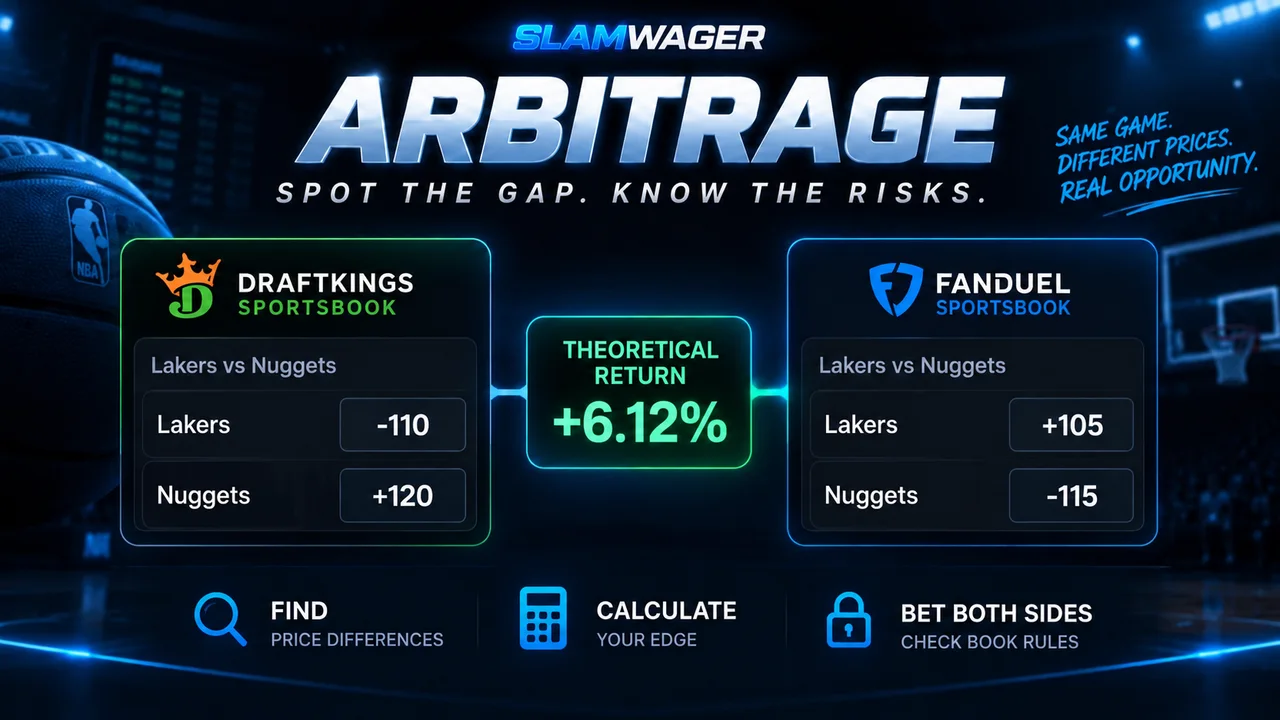
Arbitrage: spot the gap, understand the catch
Learn arbitrage betting with worked payouts, a three-way example and an interactive quiz. Spot pricing gaps, missing outcomes and settlement traps.
Illustrative prices, not live offers. Returns depend on both bets being accepted and matching settlement rules.
One game. Different prices. Every outcome covered.
Arbitrage is a pricing relationship, not a prediction about who wins. If different books offer prices that let correctly sized stakes cover every mutually exclusive result and return more than the total staked, the quoted market has a mathematical arbitrage opportunity.
All examples here use made-up training prices, not live offers. They assume every bet is accepted at the shown odds and settles under identical rules. Real execution can fail; this is education, not a recommendation to place bets.
The test: do the implied probabilities add to less than 100%?
Convert American odds to decimal: +110 becomes 2.10; -125 becomes 1.80. For positive American odds A, decimal odds = 1 + A/100. For negative odds, decimal odds = 1 + 100/|A|. Decimal odds include the returned stake.
For each possible result, calculate 1 ÷ decimal odds. Add those figures. Below 1 means a mathematical pricing gap; exactly 1 means break-even before costs; above 1 means the prices do not create an arbitrage. This test is valid only when the outcomes fully cover the same market.
Let S be that sum and B the total example stake. Allocate B × (1/decimal odds) ÷ S to each result. Before rounding or costs, the equal return is B ÷ S and the return on total stake is (1 ÷ S) − 1. Do not mistake 1 − S for that return.
Three outcomes means three bets—not two
A hypothetical 90-minute soccer market offers Home 3.10, Draw 3.60 and Away 3.10 across different books. The sum is approximately 92.29%, below 100%. A $100 training allocation is about $34.95 / $30.10 / $34.95. Depending on the result, the gross return is about $108.35–$108.36, before costs. Omitting the draw would leave an uncovered outcome.
A three-way regulation result is not the same market as a two-way team-to-advance bet. Extra time, penalties, pushes, retirements and void rules must match. Attractive-looking odds cannot repair different contracts.
Why a real opportunity can still lose money
The second price can move after the first bet is accepted. A book may accept only part of a stake, apply a limit or reject a bet. That leaves an exposed position rather than a completed arbitrage. Do not assume a displayed quote is an accepted ticket.
Fees, commission, currency conversion and cent rounding can consume a small gap. A void or different settlement rule can remove the coverage. Check the actual market rules and terms at each operator; account restrictions and applicable taxes also matter.
This differs from positive expected value, which depends on a probability estimate, and from a middle, which targets an overlap between lines. Neither automatically provides a positive return in every outcome. Never chase an unmatched leg by increasing stakes to recover a loss.
WORKED EXAMPLE / TRAINING PRICES
Follow the whole $100.
Hawks +110 at Book A. Wolves +105 at Book B. Same two-outcome market; no draw, push, void or fees in this example. The combined implied probability is 96.40%.
Hawks +110 / 2.10
$49.40
Allocated stake
Wolves +105 / 2.05
$50.60
Allocated stake
Choose the result. What comes back?
Winning ticket returns $103.74, including its stake.
Other ticket returns $0. Subtract the entire $100 staked—not just the winning stake.
Net example profit: $3.74
Cent-rounded allocations make the two returns slightly different. These are calculated training outcomes, not available prices or guaranteed real-world profit.
YOUR TURN / THREE CHALLENGES
Which one is the arbitrage?
Pick one answer per challenge. Your first answer counts; the explanation reveals the catch.
Sources
Frequently asked questions
Is arbitrage risk-free?
The arithmetic can show a positive payout in each modeled outcome. That does not eliminate execution, limit, fee, settlement or counterparty risks.
Are two plus-money prices enough?
Only if they cover every result of the exact same market with compatible rules and the net payout remains positive after costs.
Keep reading

American, decimal and fractional odds decoded, how to turn any price into a break-even percentage, how to strip out the sportsbook's cut, and why a few cents of price matter more than most picks.
How to calculate expected value for any bet, where your probability estimate should come from, how big the swings around EV really are, and the mistakes that make +EV bets lose money.

A unit is your standard bet size, usually 1–2% of your bankroll. How to set yours, read a +10u record, and spot misleading unit claims.